Dr. Joel Albert, Aurangabad
The human tongue possesses an extraordinary power, capable of encouraging the weary or even pulling down the strong. When an individual is brought into the glorious light of Christ, every aspect of their life is subjected to a divine transformation. This marvelous regeneration must undoubtedly extend to the very words that fall from our lips. As believers, we are not merely called to silence the angry outbursts of our former lives but rather, we are given a completely new vocabulary of grace.
The scriptures point our gaze constantly toward our Saviour as the ultimate standard. The psalmist prophetically declared of Him, "Grace is poured into thy lips" (Psalm 45:2). Even the hardened officers sent to arrest Christ returned empty-handed, utterly captivated by His discourse, confessing, "No man ever spoke like this Man!" (John 7:46).
In Him, we see no idle chatter, no corrupt communication, and no words spoken in haste. If we are to walk worthy of our calling, our daily speech must increasingly reflect the matchless grace and divine wisdom of the One we follow. The words we choose show us the condition of our hearts, dictating the spiritual atmosphere of our homes and assemblies.
1. The Solemnity of Speech
We must begin our examination of Christian speech exactly where the Lord Jesus Himself began: with the sobering reality of divine accountability. The world treats words very cheaply, but the believer must recognize that every word that comes out of our mouth carries eternal weight and infinite significance.
The Lord Jesus delivered a strong warning when He stated, "But I say unto you, that every idle word that men shall speak, they shall give account thereof in the day of judgment" (Matthew 12:36). This solemn truth is not intended to paralyze the child of God with a spirit of fear, but rather to awaken a deep, godly reverence in terms of our language.
Our words are the most accurate spiritual barometer of our inner lives. As Christ reminded the multitudes, "Brood of vipers! How can you, being evil, speak good things? For out of the abundance of the heart the mouth speaks." (Matthew 12:34). A bitter, polluted stream cannot possibly flow from a sweet, pure source.
When we sincerely seek to tame the unruly tongue, we cannot rely on superficial behavioral modifications or mere willpower. The authentic transformation must occur in the hidden chambers of the heart, forged through deep communion with God and solid submission to His Word. With this realization we ought to pray with David, "Set a watch, O LORD, before my mouth; keep the door of my lips" (Psalm 141:3).
2. The Standard for Saints
Apostle Paul presents a glorious standard for the speech of the saints, "Let no corrupt communication proceed out of your mouth, but that which is good to the use of edifying, that it may minister grace unto the hearers" (Eph 4:29).
The word "corrupt" carries the vivid, repulsive imagery of rotting fruit that actively spreads decay and causes sickness in those who consume it. Corrupt communication includes gossip, unnecessary criticism, manipulation, flattery, and the sowing of discord among brethren etc. Instead of falling into these destructive habits, our speech must intentionally minister grace to the hearers.
Every single conversation, whether occurring in the quiet confines of our living rooms, marketplace, or the gathering of the saints, presents a divinely appointed opportunity to share God's Grace with others. We are called to meticulously observe the spiritual needs of those around us and offer words that build up the broken, encourage the fainthearted, and strengthen the weary.
3. The Seasoning of Salt
This delicate, beautiful balance of truth and grace is further illuminated in Paul’s letter to the Colossians, providing practical instruction for our daily interactions with both the saved and the unsaved. He writes, "Let your speech always be with grace, seasoned with salt, that you may know how you ought to answer each one," (Colo 4:6).
In the ancient world, salt was a vital, precious commodity used primarily to preserve meat from corruption and to add necessary flavour to a meal. Our words, therefore, must act as a powerful preserving agent in a world characterized by moral decay. Christian speech should boldly arrest and cut off the spread of spiritual impurity and introduce a standard of holiness into every environment we enter.
However, it must also be perfectly seasoned. There is a sense of limit and balance in that word! Salt applied too heavily ruins the meal, and similarly truth delivered without the warmth of genuine empathy can deeply, unnecessarily wound the hearer. Our speech should be perfectly suited to the occasion.
When believers engage with the unbelieving world, our words should not be marked by pride or superiority, or even intellectual arrogance and arguments.
Rather, they should reflect the tender compassion and truth of our Saviour, causing others to marvel, just as the multitudes "wondered at the gracious words which proceeded out of his mouth" (Luke 4:22).
4. The Song of the Sanctified
The ultimate and highest use of the human tongue is not merely to communicate with our fellow humans, but to offer unceasing praise to our God and our Saviour. A heart that has been thoroughly washed in the precious blood of the Lamb cannot possibly remain silent; it must overflow with joyous thanksgiving, (Eph 5: 19, 20).
A tongue dedicated to thanksgiving leaves absolutely no room for murmuring or complaining. When we actively, intentionally cultivate a vocabulary of gratitude, we build a powerful defense against the deceptive snares of the enemy. Our words become a living, breathing testimony to the absolute sufficiency of Christ and the goodness of God, regardless of the trials, tribulations, and storms we may face in this earthly pilgrimage.
Conclusion
We must humbly and honestly acknowledge that governing the tongue is a lifelong pursuit, a daily, intense spiritual battle. That requires the continual, enabling power of the Holy Spirit. We must consciously and deliberately surrender our lips to the Lord each morning, asking Him to purify our thoughts, sanctify our motives, and carefully guide our words throughout the day.
May the earnest cry of the psalmist become the quiet rhythm of our own spiritual lives: "Let the words of my mouth and the meditation of my heart Be acceptable in Your sight, O LORD, my strength and my Redeemer" (Psalm 19:14). As we eagerly wait for the glorious return of our Saviour, let us strive by His enabling grace to speak in a manner that reflects His boundless love and honours His eternal truth.
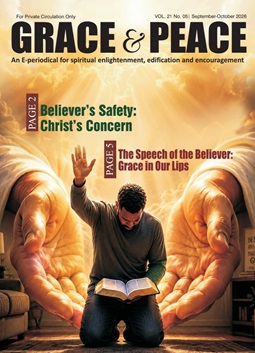
Grace & Peace e-periodical
Vol. 21 No. 05 september - October 2026
In this issue: -
Editorial: Divine Protection
Perspective: Believer's Safety: Christ's Concern
Study:1 The Speech of the Believer: Grace in Our Lips
Reflections: The Roles of Angels towards Christ-2
Practical: When Words Become Weapons - 2
Study 2: Preparation to Fight- 2
Outline-1 Our Protectors
Outline:- 2 Heavenly Provision
Anecdote:- 3 Footprints
|