Perspective
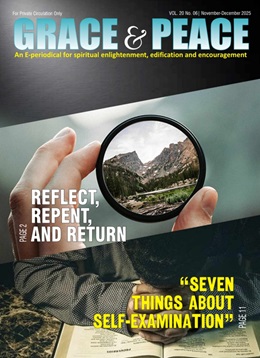
REFLECT, REPENT AND RETURN, Lam 3:40-41
“
"Let us search out and examine our ways, And turn back to the LORD; Let us lift our hearts and hands to God in heaven", (Lamentations 3 39 - 41).
Nelson Thomas, Mumbai
Prophet Jeremiah's admonition to the people of Judah is relevant for God's people everywhere, of all time, particularly as we approach
the end of another year.
He is weeping, seeing the destruction of Jerusalem by the Babylonians. Around 40 years ago, Jeremiah began to warn Judah about the impending judgment of God against their sins and rebellion. But they never paid any attention.
Now his prophecies have come to pass; the city is broken, the Temple desecrated, possessions looted, and people were taken into captivity. Witnessing this utter destruction broke the heart of Jeremiah, the ‘weeping prophet’ (Lam. 3:48, 49; Jer 9:1). Instead of rebuking or ridiculing the people now, he identifies with them in their pain and sorrow, lamenting.
From Despair to Hope
From chapter 1:1 to 3:18, he was focusing on himself and his troubles. But from 3:19 onwards, his tone is different. Instead of focusing on himself, Jeremiah began to look to God, who is his portion (v. 24), and meditated upon His mercy, compassion, and faithfulness (vs. 22, 23). And the result is, he found hope in the Lord (vs. 21b, 24b, 26, 29).
That’s a wonderful truth; concentrating on ourselves and our troubles makes us desperate and helpless. Whereas focusing on the Lord and His attributes enlightens and encourages us. Even others too benefit from such positive viewpoints.
Notice some of the lessons that Jeremiah understood that transformed him from hopelessness to hopefulness:
God does not afflict us willingly, v. 33. He finds no pleasure in our pain and sorrow.
Even as He causes grief, He is still compassionate with us, v. 32 cf. 2Tim. 2:13. Any divine chastening reflects His love and care towards us as a Father, (Pro. 3:11, 12; Psa. 89:31–33).
God will not cast us forever, v. 31cf. Psa. 103:9. No suffering is for eternity.
It is in this context that Jeremiah is calling upon the people of Judah to reflect, repent, and return to the Lord amid the calamities they are facing.
Search out and examine, v. 40
Judah is reaping the consequences of their own sin. It is not the time to complain but to introspect sincerely (v. 39). More than concentrating on their present sorrow, they need to look back and evaluate the kind of life they lived in the past.
This is exactly what any believer should do, not just at sufferings, but even as a regular spiritual exercise. Deliberately consider the past and evaluate in the light of God’s Word.
What to examine?
Our ways, Jer. 3:40
‘Ways’ refers to our way of life or lifestyle. The way we conduct our day-to-day life before God and man. Is it acceptable to God and honourable before men (cf. Phil 1:27; 1Pet 2:12)?
Our heart, 1Cor. 11:28
Here, Paul exhorts the Corinthians to examine themselves before partaking of the Lord’s table. Participating in the bread and cup should not be done in a ritualistic manner, but sincerely pondering upon the preciousness of the Lord Jesus and His works for us.
Our hearts must be filled with love and appreciation for Him. So, we ought to examine our heart, which is the centre of our love and affections, to see if any indifference, irritation, or bitterness fills our heart as that can make us unworthy for the Lord’s Supper (cf. Isa. 29:13).
Our faith, 2Cor. 13:5
Faith may refer to the teachings that we follow as well as our trust in the Lord. There are ‘doctrines of demons’ as well as ‘faith’ that Christ does not endorse! (cf. 1Tim. 4:1; John 2:23, 24).
Our works, Gal. 6:4
Works may refer to any service that we do in the name of the Lord. Paul elaborates it in 1Cor. 3:10 onwards. We need to check the foundation, the materials used, and even the motive behind any ministry. There should be no selfish agenda in the Lord’s work.
Our inability
However, the scripture teaches categorically that no man can examine himself or even others. Jeremiah himself wrote, “The heart is deceitful above all things, and desperately wicked; Who can know it?” (Jer. 17:9).
We are well aware of the fact that no one knows the heart of another, but it’s also true that even we ourselves fail to know everything about our own hearts. For the heart is ‘deceitful above all things’. As the wise man says, all our ways are right in our own eyes, even while treading the way to death (Pro. 16:2, 25).
Remember the prayer of the Pharisee, “God, I thank You that I am not like other men—extortioners, unjust, adulterers, or even as this tax collector. I fast twice a week; I give tithes of all that I possess” (Luke 18:11, 12). This is the way most men think and project themselves (cf. 1Cor 4:3–5).
That’s why, for a true self-examination, we ought to plead with the Lord as the psalmist did, “Search me, O God, and know my heart; Try me, and know my anxieties; And see if there is any wicked way in me, And lead me in the way everlasting” (Psa. 139:23, 24). Pray as Elihu suggested to Job, “Teach me what I do not see” (Job 34:31).
God’s Penetrating Eyes
The risen Lord Jesus reminded the church at Thyatira that He searches the minds and hearts of men, for His eyes are like a flame of fire (Rev. 2:18, 23). His words to the church of the Laodiceans are noteworthy, “you say, 'I am rich, have become wealthy, and need nothing'—and do not know that you are wretched, miserable, poor, blind, and naked” (Rev 3:17).
That’s exactly what happens when we intentionally allow the light of God to shine upon our lives. His penetrating rays will scan our innermost parts and reveal the hidden things to light.
Repent and return, v. 40b
Just as Christ further counsels the Laodiceans to come to Him to remove their poverty, nakedness and blindness, we ought to come to His feet (Rev. 3:18). That involves not just a realisation of our failed state, but a hatred towards evil and a genuine sorrow over the past failure as well. That’s why Jeremiah wrote, “And turn back to the LORD; Let us lift our hearts and hands To God in heaven” (Lam. 3:40b, 41).
Any refusal to forsake the sinful ways and behaviour only proves our hypocrisy. Sincere self-examination is to get rid of anything that is against God’s will and confess to the Lord who “is faithful and just to forgive us our sins and to cleanse us from all unrighteousness” (1John 1:9). G&P