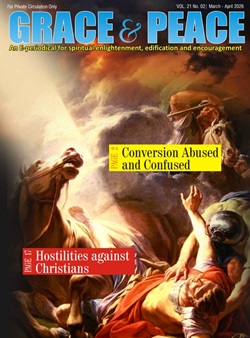
Conversion is the buzzword again in India today. Though we all use this term in our everyday usage like digital conversion or currency conversion, religious conversion has become the talk of the town now. Certain fraudulent conversions that took place in a corporate corridor have sent shock waves across the country.
When on one side there are different kinds of 'conversions' for progress and development, religious 'conversion' has become a contentious and controversial topic. An impression has been cast that any form of spiritual conversion should be suspected as a criminal offense.
In the background of such confused situation let us consider briefly what the Bible says about conversion in the Biblical point of view:
1. Whether in the Old Testament or New Testament the original terms used for 'conversion' means, 'to turn about,' 'turning towards,' 'to turn back,' etc. (Psa. 51:13; Matt. 18:3; Acts 15:3). It refers to a change from one form or state to another.
2.Thus, in the in the Biblical context 'conversion' refers to the act of man turning from all that is unscriptural to scriptural. That includes turning from idols to the living God, from darkness to light, falsehood to truth, bondage to freedom, death to life, etc. (1Thess 1:9; John 5:24). It's a change of mind, not a name or religion.
3.True Biblical conversion is always preceded by conviction, repentance, and faith. Conviction is the personal acknowledgement of one's sinfulness as the scripture rightly reveals. Repentance is the change of mind with sorrow and hatred for the past evil life. Faith is the committing of oneself to the Lordship of Christ, trusting in His promises (Acts 3:19; 26:20).
4. Conversion itself is not salvation or regeneration; however, it is only when one is genuinely converted, God graciously forgives his sins, regenerates and declares him righteous in Christ (Isa. 1:16-18; Acts 3:19). The Lord Jesus asserts that without conversion one is unfit for the kingdom of heaven, irrespective of which community one belongs to, Matthew 18:3.
5. Even though conversion is the act of an individual, there is a divine work involved in it which is often beyond human comprehension. Using the Word of God the Holy Spirit works from without to bring conviction in the heart of an individual (Psa. 19:7; John 16:8; 1Pet. 1:2). God in His sovereign grace enables one to turn around at the right time. The conversion of Saul of Tarsus is the best example for this supernatural involvement (Acts 9:1–18; 9:7).
5. Even though conversion is the act of an individual, there is a divine work involved in it which is often beyond human comprehension. Using the Word of God the Holy Spirit works from without to bring conviction in the heart of an individual (Psa. 19:7; John 16:8; 1Pet. 1:2). God in His sovereign grace enables one to turn around at the right time. The conversion of Saul of Tarsus is the best example for this supernatural involvement (Acts 9:1-18; 9:7).
6. God always expects a genuine convert to educate those who live in darkness and evil ways to turn to Him (Psa. 51:13; James 5:19, 20). In the Old Testament, God wanted Israel to be a light unto the Gentiles, (Isa. 42:6; 49:6). Similarly, Saul of Tarsus was miraculously transformed to be a witness to the Gentiles, (Acts 26:18). As a matter of fact, a personal experience of conversion alone makes one eternally grateful to God for the mercy and grace he obtained. And in turn that makes one a zealous witness for the Lord.
7. Any false or forced conversion is deplorable and strictly rebuked (Acts 8:13, 21, 22; Matt. 7:21-23). Conversion of an individual must be purely voluntary and based on clear understanding of the Word of God (Matt. 13:15). The Lord Jesus never forced anyone to follow Him, in fact He even suggested the Apostles to leave (Luke 14:27; John 6:66, 67).
8. True conversion results in a dramatic transformation internally as well externally. Plenty of conversion stories in the New Testament substantiate it. Apostolic instructions to new converts present the expected way of life, worthy of the Lord Jesus (1Peter 2:25; 4:3; Eph. 4:17-32; Colo. 3:5-17). People who lived in gross wickedness and corruption begin to lead a holy and righteous life. This evident change becomes an example and testimony (1Thess. 1:6-10).
9. Conversion does not change one's status before men. For example, Onesimus the runaway slave from Philemon, though got converted while imprisoned at the Roman prison was still a slave to Philemon. Apostle Paul, his spiritual father acknowledges that Onesimus is still accountable to his master (Philemon vv. 10-19). The most important change a convert experiences is the new standing he gets before God and His people.
10. Conversion does not make one's life easy and prosperous. The New Testament nowhere promises a trouble-free life for the followers of Christ. On the contrary, the Lord Jesus often presented His standard of discipleship as self-sacrifice, suffering, endurance, etc. (Matt. 10:37; Luke 14:26, 27). He has even warned His followers of rejection and hatred similar of which He had to face from the world (John 15:18-21).
Then what do we achieve by conversion? It is turning away from the godless, sinful ways to God our creator who in His grace is willing to forgive our sins and regenerate us on the basis of the finished work of Christ on the cross. Apart from this new standing before God and His people, we have been blessed with all the blessings of the heavenly places. Actually, numerous are those benefits; like no more darkness, bondage, guilt, loneliness, and hopelessness, etc,.
Conclusion:
What a tragedy it is that, Biblical conversion with such profound realities is so complicated and confused in the eyes of many! Basically, it is because of the ignorance of the people regarding Biblical truths. At the same time, corrupt and fraudulent practices by certain groups also led people to view conversion with suspicion.
In this scenario let us understand and experience true conversion according to the Word of God. Let's make sure that we who claim to have been converted are real and the transformation is visible. It is high time we live out the gospel more than the proclamation of it. G&P